
Search marketing is no longer simply about ranking on Google — it’s about being visible everywhere your audience searches. The digital landscape is shifting rapidly from AI-driven chat tools to voice assistants and generative search experiences. For companies that want to remain competitive, understanding and adapting to AIO (Artificial Intelligence Optimization), GEO (Generative Engine Optimization), and Search Everywhere Optimization is no longer optional — it’s essential.
The Shift in Search Behavior
1. The Rise of AI-Driven Search
Artificial intelligence is transforming how people find information online. In 2024, 20% of Americans used AI tools at least 10 times per month, while 95% still relied on traditional search engines — showing that AI is supplementing, not replacing, Google-style search1.
Furthermore, 94% of marketing organizations now use AI in their campaigns2, and 65% of businesses report improved SEO results with AI integration3.
Even so, the nature of search results is changing. Over 58% of Google searches are now “zero-click”, meaning users find answers directly on the search page without visiting a website4.
The takeaway: visibility no longer means just being “ranked” — it means being “referenced” by AI systems and trusted sources.
2. Voice, Local, and Conversational Search
Voice assistants are now a part of everyday life. More than 20.5% of people worldwide use voice search, and there are over 153 million voice assistant users in the U.S.5. Around 22% of all voice searches are location-based, and 76% of smart speaker queries are “near me” searches6.
This trend is huge for local businesses — 8 in 10 U.S. consumers search for a local business online weekly7.
Companies that optimize for voice and local intent — with conversational phrasing, structured data, and accurate Google Business Profiles — will dominate in this environment.
3. Generative Engine Optimization (GEO)
Generative Engine Optimization, or GEO, refers to optimizing content so AI-driven systems (like ChatGPT, Gemini, Copilot, or Perplexity) can reference, summarize, or cite your brand. These engines rely heavily on structured data, schema markup, and credible third-party mentions.
Rather than focusing only on keyword rankings, GEO emphasizes authority and trust. AI systems tend to pull answers from reputable sources — including industry publications, news outlets, and expert blogs8. That’s why having your company referenced externally and publishing authoritative content internally is critical.
4. Local Presence Still Matters
Even as AI reshapes discovery, local visibility remains foundational. 80% of U.S. consumers look up a local business at least once per week7, and Google’s local pack still drives significant lead volume for service-based companies. Local presence becomes the connective tissue that links visibility across all search channels when layered with voice and AI discovery.
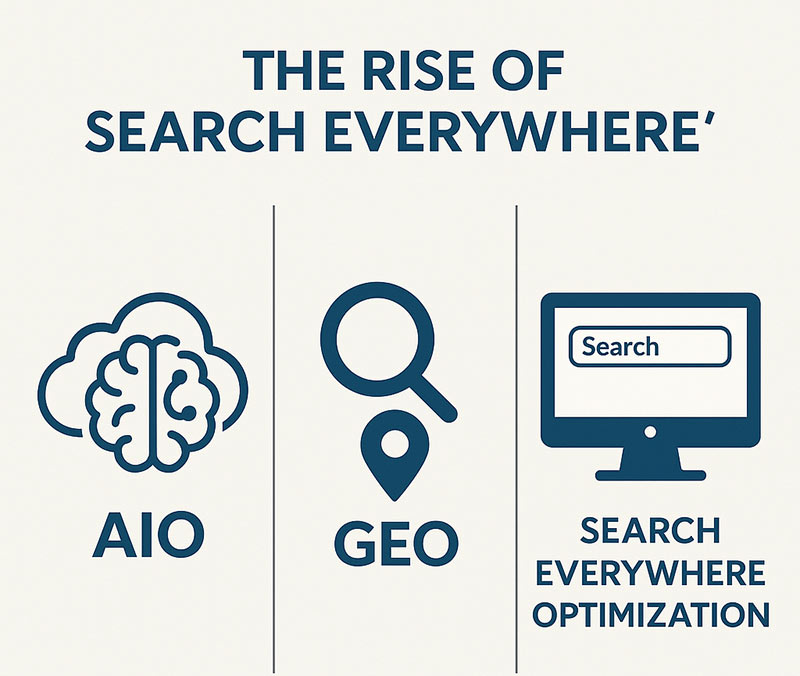 What the Shift Looks Like in Practice
For Users
The modern search journey might look like this:
-
A user asks Siri: “Find a roofing company near Hartford with five-star reviews.”
-
Or types into an AI chat interface: “What are the best medical billing services for FQHCs?”
In both cases, the response may come from aggregated data, AI summaries, or voice results — not necessarily from clicking a traditional search result.
For Businesses
Traditional SEO tactics — backlinks and keyword density — are no longer enough. Companies must now:
-
Be visible in AI-generated summaries
-
Optimize for voice and conversational intent
-
Strengthen local and geo-based signals
-
Build third-party credibility through reviews and mentions
Companies that adapt now will enjoy a compounding visibility advantage over competitors who don’t.
Why It Matters — and Why Now
1. Users Are Searching Differently
AI, voice, and chat interfaces are influencing people’s questions and how they expect answers to appear. Traditional rankings still matter, but context and authority now matter more.
2. Competitive Advantage
Early adopters of AIO and GEO are already capturing new traffic streams. As AI search expands, its visibility will multiply — while others scramble to catch up.
3. Relevance and Trust
Generative search systems pull from trusted, structured sources. Investing in schema markup, FAQs, and authoritative content ensures these systems recognize your business as credible.
4. Measurable ROI
Voice and local searches convert at higher rates because they’re intent-driven. Capturing this traffic early increases lead quality and lowers acquisition costs9.
What Businesses Should Do
Phase 1: Audit & Baseline
-
Evaluate your current visibility: SEO, local, and AI mentions
-
Assess structured data, schema, and NAP consistency
-
Audit where your brand is cited online
Phase 2: Optimize for “Search Everywhere”
-
Update your website with schema, FAQs, and conversational phrasing
-
Optimize your Google Business Profile and local citations
-
Implement voice-search-friendly content
-
Publish content AI tools can cite (credible, well-structured, non-promotional)
Phase 3: Integrate AIO and GEO Strategy
-
Create AI-ready content that answers real-world questions
-
Build backlinks from authoritative industry publications
-
Develop a digital PR strategy to earn trusted mentions
Phase 4: Monitor and Iterate
-
Track local/voice conversions, featured snippets, and AI mentions
-
Review and refine content quarterly based on user behavior trends
When to Bring in Kieffer Consulting
Partner with Kieffer Consulting when:
-
You’re ready to modernize your SEO into a Search Everywhere strategy.
-
You want to combine local SEO, voice optimization, and AI visibility into one cohesive system.
-
You’re focused on measurable ROI and not just rankings.
-
You need a long-term digital strategy that positions your business as an industry authority across every search environment.
Kieffer Consulting helps companies integrate AIO, GEO, and SEO into a unified strategy that drives leads, builds authority, and ensures long-term discoverability — no matter how search evolves next.
Key Takeaways
-
AI-powered search is redefining visibility.
-
Voice and local intent are growing fast.
-
GEO and AIO are the new frontiers of marketing visibility.
-
Structured data, authority, and credibility matter more than ever.
-
Now is the time to act — before your competitors do.
Sources
-
SparkToro. New Research: 20% of Americans Use AI Tools 10x/Month, but Traditional Search Hasn’t Dipped. https://sparktoro.com/blog/new-research-20-of-americans-use-ai-tools-10x-month-but-growth-is-slowing-and-traditional-search-hasnt-dipped/ ↩
-
Martech.org. AI and Marketing: What the Stats Show (2024). https://martech.org/ai-and-marketing-what-the-stats-show/ ↩
-
Mailmodo. AI SEO Statistics (2024). https://www.mailmodo.com/guides/ai-seo-statistics/ ↩
-
Break the Web. AI SEO Statistics You Need to Know. https://breaktheweb.agency/seo/ai-seo-statistics/ ↩
-
DemandSage. Voice Search Statistics 2025. https://www.demandsage.com/voice-search-statistics/ ↩
-
Synup. Voice Search Statistics. https://www.synup.com/en/voice-search-statistics ↩
-
Backlinko. Local SEO Statistics 2024. https://backlinko.com/local-seo-stats ↩ ↩2
-
Campaign Creators. Master AI Search with GEO (Generative Engine Optimization). https://www.campaigncreators.com/blog/master-ai-search-with-geo-generative-engine-optimization ↩
-
Reuters. AI-Driven Search Ad Spending Set to Surge to $26 Billion by 2029. https://www.reuters.com/business/media-telecom/ai-driven-search-ad-spending-set-surge-26-billion-by-2029-data-shows-2025-06-04/ ↩